Choosing a self-hosted PyPI server
Six open-source PyPI servers and two commercial platforms cover the field. They split cleanly by what they were built to do: host your private packages, mirror public PyPI, proxy PyPI on demand, or all three. Start from the job you have.
| Tool | Private hosting | Proxy/cache PyPI | Full mirror | Cloud storage | No database | Speed |
|---|---|---|---|---|---|---|
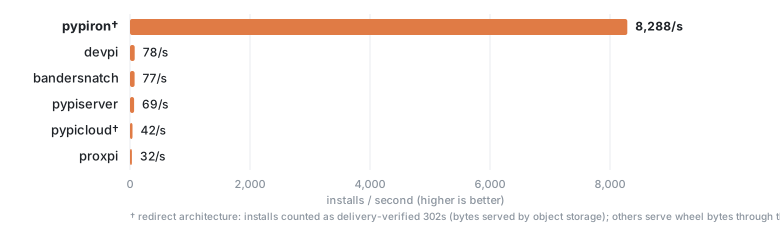
| pypiron | ✅ | ✅ | ✅ (filtered) | S3, GCS, Azure | ✅ | 8,288 installs/s |
| pypiserver | ✅ | redirect only | — | — | ✅ | 69/s |
| devpi | ✅ | ✅ | — | — | sqlite/postgres | 78/s |
| bandersnatch | — | — | ✅ | S3-compatible | ✅ | 77/s |
| pypicloud (archived) | ✅ | ✅ | — | S3, GCS, Azure | needs DynamoDB/SQL | 42/s |
| proxpi | — | ✅ | — | — | ✅ | 32/s |
| Artifactory / Nexus | ✅ | ✅ | — | ✅ | needs a database | commercial |
The installs/s column is each server's peak in its best cloud-backed config on one 2-vCPU box; the full six-way rig and methodology are on the benchmarks page. The byte-serving servers cluster at 32–78/s because they push every wheel through their own network card; pypiron hands the download straight to object storage and scales to CPU instead.
Which one fits
You want private packages and a PyPI cache behind one URL, fast, with cloud storage and no database to run. That is pypiron. One binary, point it at a folder or an S3/GCS/Azure bucket, and it hosts your uploads, caches public PyPI on demand, and mirrors a chosen subset — with dependency-confusion protection and a 7-day dependency cooldown on by default. It runs multi-node against one bucket and survives a region or a whole cloud going down. If that is the shape of your problem, read the vs devpi, vs pypiserver, and vs Artifactory pages.
You just need a dead-simple private index on a single box, and PyPI packages come from pypi.org directly. pypiserver is the smallest thing that works: a directory of wheels, htpasswd auth, and a fallback redirect to PyPI. It has been maintained for over a decade and does one job well. pypiron does the same job and adds caching, cloud storage, and speed — but if you never leave one machine and never want a cache, pypiserver's simplicity is hard to beat.
Your team wants a staging-and-release workflow: push a package to a test
index, run your suite against it, then promote it to a release index. That is
devpi's core strength, and pypiron does not have it. devpi's inheritable
indexes, devpi push promotion between them, and tox integration are a genuine
publishing workflow built around test-then-release. If that pipeline is what you
are buying, use devpi. pypiron treats an uploaded filename as immutable and
final — deliberately, for supply-chain safety — so it is the wrong tool for a
promote-between-indexes flow. See pypiron vs devpi.
You need a complete, offline copy of all of PyPI for an air-gapped network. bandersnatch is the reference full-mirror tool and pypiron can do filtered mirroring, but if you truly want every file PyPI has ever published on local disk or S3, bandersnatch is purpose-built for it. pypiron's mirror is designed to carry a subset — an approved allowlist, or a filter by name, wheel tags, size, or Python version — which is what most private networks actually want. Whole-of-PyPI with no filter is bandersnatch's job.
You want a caching proxy in front of PyPI and nothing else — no private uploads. proxpi is a tiny Flask proxy that does exactly this. pypiron's proxy does the same and hosts private packages too, but if a lightweight read-through cache is the entire requirement, proxpi is a smaller dependency.
You are still running pypicloud. It was archived in August 2023 and no longer maintained. It is the closest architectural peer to pypiron — cloud storage with a redirect-to-S3 read path — but it needs a database (DynamoDB or SQL) and, in the same benchmark, its Python index layer tops out at 42 installs/s against pypiron's 8,288. If you liked pypicloud's model, pypiron is the maintained successor to evaluate.
You have already standardized on Artifactory or Nexus for every artifact type in the org — Docker, Maven, npm, and Python under one commercial platform, with the access controls and support contract that come with it. Keep it. A dedicated PyPI server is not going to replace an org-wide binary manager, and it should not try. pypiron is the pick when Python is the artifact you care about and you would rather run one small self-hosted binary than license a platform. See pypiron vs Artifactory.
Honest summary
If your problem is "serve my team's private Python packages and a fast cache of public PyPI, on my own infrastructure, without running a database," pypiron is built for exactly that and is 100×+ faster than the field at it. If your problem is a staging workflow (devpi), a full offline PyPI mirror (bandersnatch), or an org-wide multi-format binary manager (Artifactory/Nexus), one of those is the better tool, and this page would rather tell you so than lose your afternoon.